
COMMUNITY
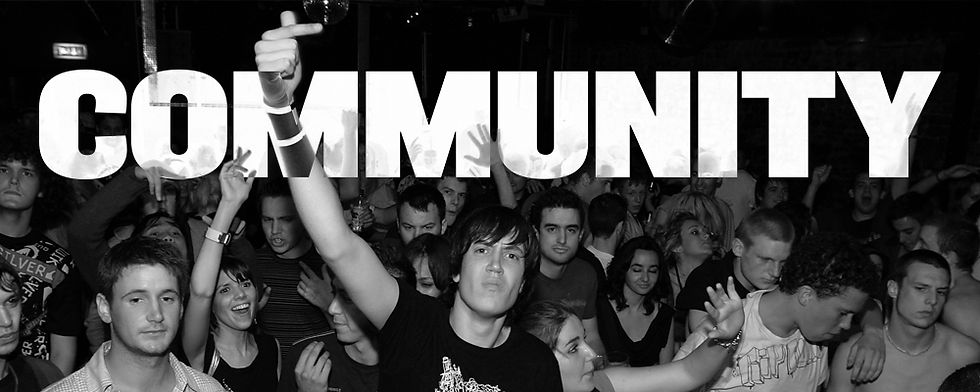
Whenever I’m out and about the most common question I get from the people who I haven’t seen recently is, ‘Will you ever promote drum and bass raves again?’ And I always get caught off-guard with it, as it brings with it so many emotions. I loved the life as a drum and bass promoter and I think I was really good at it, mainly because I really cared. From the booking, the programming, the designing, the promoting, the anxiety before, the set up, the meeting new people, the event and the take down, I loved it all and loved everyone involved. It was good life, I never got carried away, I stayed sober during the whole time (an occasional night off, but once in a blue moon) and I think this was important, I had to stay present, because what was being built wasn’t a one off night, it was a community.
The night was important for people, not just because it was a place to blow off steam, it was our meeting place, most of the conversations during the night, didn’t revolve around music, it revolved around life, peoples problems, their wins, their losses, their ideas and those conversations couldn’t be had in a place where community spirit didn’t live. People would eventually come to the nights on their own, the original big groups of people through the door, turned into individuals, because they knew they had arrived at the meeting point and beyond the doors they would know at least seventy percent of the people there and the other thirty percent were probably people they would like to meet. In comparison to todays events the night I promoted was small, a four hundred capacity black box, with towering speakers and minimal lighting, but it was the smaller clubs that were the petri-dishes of the elusive community spirit. The event lasted a decade, at least two nights a month, but sometimes four. It revolved around two nightclubs; Clwb (400 cap) and Glo Bar (250 cap) and a rare jump into the 3000 capacity student union. The high turnover of events was imperative, not only for the audience whose friendships would eventually feel like family, but also for the long list of locally talented deejays. The list was so long and their skillset so varied, events would have to be regular to keep this rag tag bunch of glorious misfits satiated. They had to feel like team players in a very individual pursuit. A lot of promoters make their life easier by having a select few DJs that play every event, but the laziness of this is both counter productive to both building a community and programming the best possible night for the people. Even though all the deejays played under the same banner of drum and bass, with little insight you can see that this umbrella term shatters into a myriad of sounds and styles just beneath the surface.
The better deejays also play with personality, some are story tellers and take the ravers on a journey, some are heads and like to draw from the dark corners and show their crate digging skills, older heads like to draw from the full timeline of D&B and others like to have a bag full of the newest upfront bangers. Some like to play fast and furious, hammering through tunes at ninety miles an hour and others like to draw out the mixes and let the music breathe. As a promoter you need to know everyones individual djing personalities and then programme the nights to serve the headline act you have booked. My normal way of programming the event would be to have a brand new DJ play the opening set, half and hour before doors opening they would start to play to an empty room but as people trickled through at doors, it would get them used to playing to an audience and making decisions under pressure. Then in my opinion the most important set, the tone setter, this DJ would have a broad knowledge and prefer the longer mixes to let the music breathe, more light and liquid in tone to start the night simmering. The next two DJ’s would be picked in their proximity in sound to the headline act, sounds that would compliment the main set without breaking the cardinal rule of playing any of the headline acts music. The headliners were the headliners and they would play however they wanted. The DJ after was also one of the most important, and were often judged on the their first tune and definitely their first mix, which would have to be quick. The vibe often rested on these five minutes, the DJ will compete with the bar, the smoking area, the toilet cubicle, get it wrong and you’ve lost the room at 2am and it is ridiculously hard to redeem yourself at this point. Get it right and the ravers will be eating out the palm of your hand until lights on and any notion of leaving the room would be left till the afters.
This revolving door of DJs and talent was the heat that kept the community petri-dish at the right temperature. DJ’s would want to check the competition, see what was working, producers would want to get their tunes in the right hands and everyone was waiting for an opportunity to shine. You literally couldn’t miss it, whether you were a raver, dj or mc. Creating this cauldron regularly meant that it didn’t matter who you booked as the headliner, the people would come and the atmosphere would be the actual selling point.
In this whirlwind I was often asked and tempted to take the night out into other cities and during my time running Aperture I always refused. It felt like I would be taking away rather than adding. I knew my city, I knew the people and how it worked, I knew how to guerrilla market there and the music people wanted to hear. Outside of Cardiff I would be another promoter trying to cash in on someone else’s postcode and not truly building a community. During the early part of Concrete Junglists I tested the theory by collaborating with other promoters in different cities and there was W’s and L’s but overall the feeling was of treading on toes. Someone else should be building here.
I’m saying all this because I believe I’m talking either about a bygone era or something as rare as rocking horse shit. I’m not saying that promoters don’t care anymore, but I think the game has completely changed making this type of attention to detail next to impossible. I’m older now so my viewpoint isn’t as it used to be, with my boots rarely being on the ground, but it looks as though the expansion of drum and bass into the mainstream has carved out a hole in the middle ground and what used to be the underground. When we were coming through to find a drum and bass act at a festival was an impossible task, but nowadays there are dedicated festivals all over the world and even the very corporate mainstream festivals are brimming with D&B. The clubs seemingly having to keep up, stack the line-ups with headliners with only the strongest surviving. From the outside the scene looks healthy and thriving, massive venues, colossal visuals, the heaviest of heavyweight sound systems, winters in Australia, New Zealand, Bali, the dream is alive and well. Surely the promoters back home who worked the trenches are raking it in, surely those who scaled the building with the aerials are sitting pretty, the DJs who slapped so hard the headliners were nervous to go on, have climbed the ladder too? Surely? The pedal pushers pushing the idea of reams of headliners, carved out the middle. The idea of creating a journey through music and deejays dashed as the agents scrambling for their DJs to be higher up the ladder. You can only have X if you take Y and Z. The art of the event disappeared, the glorious artistic flyers became laddered newsprint, the gradual move through bpms, tempos, vibes became hour after hour of all out assault on the ears, nobody willing to take a section of the assent to the peak. Everyone wanting to fly their own flag at the summit. Its a different world now, the community spirit is dashed to favour the individual, the local unknowns strictly locked in their bedroom unless they master the skillsets of DJing, Producing, Social Media, friends with an agent, know someone at Spotify.
So when people ask ‘Will you ever promote drum and bass raves again?’ I just look back and think how hard it would be to get the community together, having to rally against a system thats geared for the rich to get richer and the communities to keep getting split. Drum and Bass has always been a mirror towards society as I believe its the closest musical art form to the actual pulse of the community. The cost of living crisis could also be said to be a cost of community crisis too. I don’t know the answer so I do the thing that I’ve always known and create artwork to celebrate the culture. But to do events again, brings back so many emotions.


Comments